
Introduction
100% easy notes Unit 4, Differential Equations, from the New NBF Mathematics Book Class 12 FBISE 2026-27, complete with order/degree tables, step-by-step methods, and answers matching the FBISE marking scheme, prepared by HSA Notes. Perfect for FBISE HSSC-II exams in April 2026, these notes are designed to help students score 90 plus marks with ease.
🎓 Online Classes with Experienced Experts
Exercise 4.1, Order, Degree & Forming Differential Equations (All Questions Solved)
- Exercise 4.1 Complete Solved + Order/Degree Table
- Order & Degree of All Equations, Q1(i–vii)
- Radical Removal for Degree, Short Trick
- Forming a DE from a Given Solution, Q2(i–iv)
- Verifying a Given Function Solves a DE, Q3
Exercise 4.1 sets up the vocabulary the rest of the unit relies on. Identifying order is usually straightforward, but degree can trip students up whenever the equation contains a radical or fractional power the notes show the radical-removal trick clearly before reading off the degree, so the process is repeatable on any similar question.
Forming a differential equation from a given general solution, covered in Q2, is solved by differentiating enough times to eliminate every arbitrary constant, with each step shown so students can see exactly how many constants determine how many derivatives are needed.
Exercise 4.2, Separable Variables Differential Equations
Full Solutions + Methods
- Exercise 4.2 Complete Solutions
- Standard dy/dx = f(x)g(y) Separation Method
This exercise introduces the first real solving technique of the unit: rearranging an equation so that every x-term sits on one side and every y-term on the other, then integrating both sides. It’s a short exercise, but an important one, since separation of variables is often the first thing worth checking before reaching for a more complicated method later in the unit.
Exercises 4.3 to 4.7 + Review Exercise, Fully Solved
- Exercise 4.3 — Homogeneous Differential Equations
- Exercise 4.4 — Exact Differential Equations & Integrating Factor
- Exercise 4.5 — Linear Differential Equations, Bernoulli Form
- Exercise 4.6 — Orthogonal Trajectories
- Exercise 4.7 — Applications: Growth/Decay, Mixing Problems
- Review Exercise, Unit 4 — MCQs and long questions, fully solved
These exercises build the full toolkit for handling first-order differential equations. Exercise 4.3 shows how to recognize a homogeneous equation and reduce it to a separable one using the standard y = vx substitution.
Exercise 4.4 covers exact equations, along with the integrating factor method for equations that aren’t exact to begin with a step where sign errors are common, so each solution is worked carefully term by term.
Exercise 4.5 tackles linear and Bernoulli-form equations, which come up frequently in board papers, while Exercise 4.6 uses differentiation and separation together to find families of curves that intersect at right angles.
Exercise 4.7 closes the unit with applied problems population growth, radioactive decay, and mixing tanks where setting up the correct differential equation from the word problem is often harder than solving it, so the notes spend extra time on the setup, not just the solution.
Sample Questions
From Exercise 4.1:
- Find the order and degree of d²y/dx² + (dy/dx)³ − y = 0
- Form the differential equation for y = mx + c
- Verify that y = e^(−x/2) satisfies 2y′ + y = 0
From Exercise 4.2:
4. Solve dy/dx = xy
From Exercise 4.3:
5. Solve (x² + y²)dx − 2xy dy = 0
From Exercise 4.5:
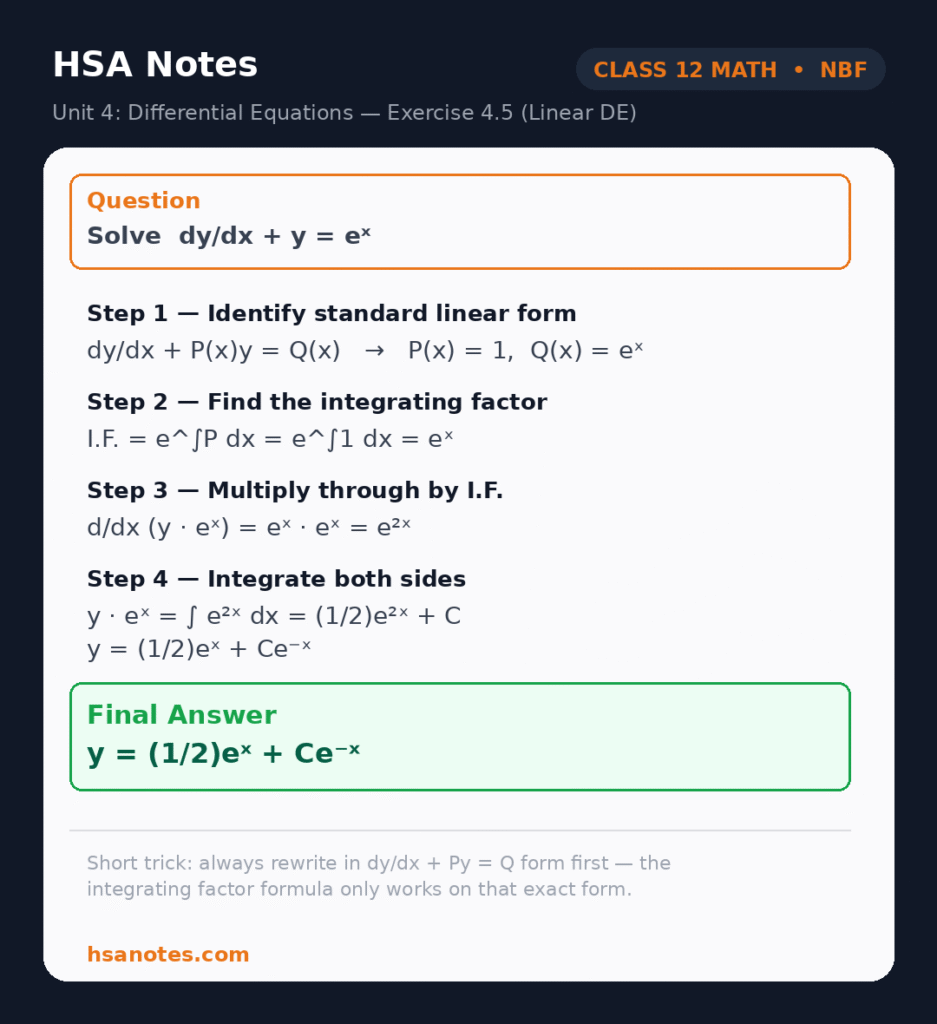
6. Solve dy/dx + y = eˣ
From Exercise 4.6:
7. Find the orthogonal trajectories of the family y = cx²
From Exercise 4.7:
8. A population grows at a rate proportional to its size. If it doubles in 5 years, find the growth constant.
Why This Unit Matters
Differential equations are where calculus stops being abstract and starts modeling real change — populations, cooling objects, decaying substances, mixing solutions.
Correctly classifying an equation’s order, degree, and type, covered in Exercise 4.1, is the foundation every later technique in the unit depends on, since applying the wrong method to the wrong type of equation is one of the most common ways marks are lost. Linear equations and applications, covered in Exercises 4.5 and 4.7, are consistently favored in FBISE long questions, making them especially worth mastering before the board exam.
HSA Notes Features
- Complete solved exercises from 4.1 through 4.7, plus the review exercise
- Order/degree tables and classification guidance for every equation type
- Step-by-step methods matching the FBISE marking scheme
- Exam-focused preparation for HSSC-II board exams
- Full Unit 4 notes available to study online at hsanotes.com
Join Online Classes
Join HSA Notes online classes to strengthen your differential equations technique, and every other unit of Class 12 Math, with regular practice to help you aim for 90 plus marks in your FBISE HSSC-II board exam.
Contact: hsanotes48@gmail.com
Frequently Asked Questions
How do I find the order and degree of a differential equation?
Order is the highest derivative appearing in the equation, while degree is the power of that highest derivative after the equation has been cleared of radicals and fractions involving derivatives.
How is a differential equation formed from a general solution?
By differentiating the given solution as many times as there are arbitrary constants, then eliminating those constants through algebraic substitution to leave an equation involving only x, y, and derivatives.
What’s the difference between separable, homogeneous, and exact equations?
Separable equations can be rearranged so all x-terms and y-terms are on opposite sides; homogeneous equations become separable after a y = vx substitution; exact equations satisfy a specific partial-derivative condition and can be solved directly or with an integrating factor.
Are these notes aligned with the current FBISE NBF syllabus?
Yes, these notes are fully solved according to the New NBF Mathematics Book for Class 12, FBISE, 2024-25, and follow the official FBISE marking scheme.
Conclusion
With Unit 4, Differential Equations, fully solved from Exercise 4.1 through the review exercise, Class 12 FBISE students have a complete, exam-ready resource covering one of the most method-heavy units in the Math syllabus. Practice these solved exercises alongside past papers, and consider joining our online classes for guided, exam-focused preparation, to build the accuracy and confidence needed for your HSSC-II board exam.
Best of luck for your Class 12 Math exam!