
Introduction
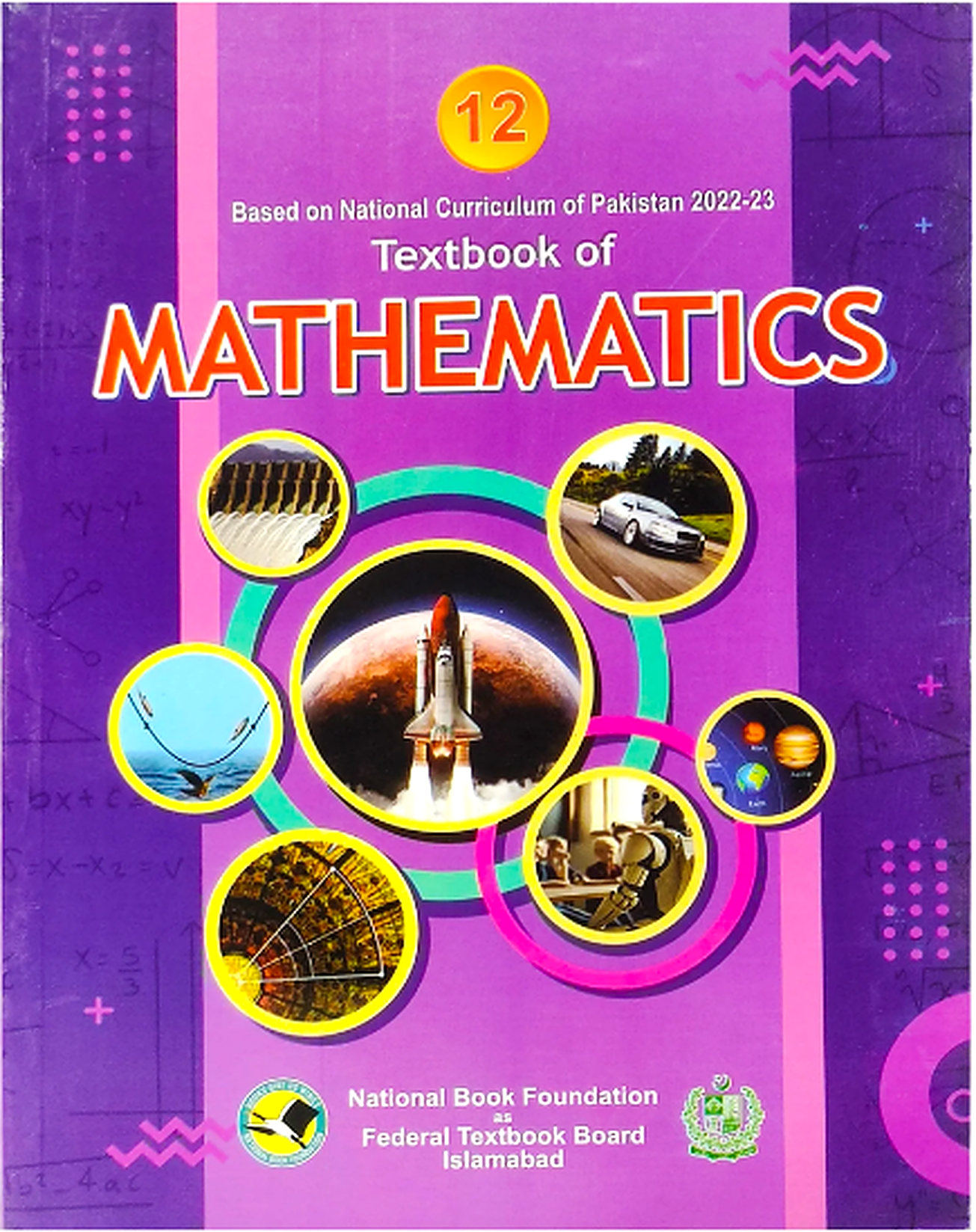
100% solved Unit 3, Integration, from the New NBF Mathematics Book Class 12 FBISE 2024-25, complete with original graphs, short tricks, and answers matching the FBISE marking scheme, prepared by HSA Notes. Perfect for FBISE HSSC-II exams in April 2026, these notes are designed to help students score 90 plus marks with ease.
🎓 Online Classes with Experienced Experts
Unit 3 is where the differentiation skills built in Unit 2 get turned around and applied in reverse. It’s a long chapter, spanning eight exercises plus a review exercise, moving from basic indefinite integrals through trigonometric integration, substitution, integration by parts, partial fractions, and finally definite integrals with their geometric applications.
Because each exercise leans on techniques from the one before it, working through Unit 3 in order rather than jumping to favorite question types is the surest way to avoid gaps before the board exam.
Exercise 3.1, Indefinite Integrals (All Questions + Original Graphs Solved)
Full Solutions with Graphs
- Power Rule & Polynomial Integrals
- Roots, Exponential & Logarithmic Integrals
- Short Tricks for Exponential-Times-Variable Forms
- Mixed Exponential Bases & Substitution Setups
- Split Integrals, Logarithmic and Arctan Results
- Chain Rule and Advanced Substitution, Later Questions
Exercise 3.1 lays the groundwork for everything that follows, introducing the reverse power rule alongside standard exponential and logarithmic integral forms. A few later questions combine substitution with recognizing a derivative pattern hidden inside the integrand — these are solved with full reasoning shown, not just the final antiderivative, so students can learn to spot the pattern themselves.
Exercise 3.2, Integration of Trigonometric Functions (100% Solved)
- Standard Sin, Cos, Tan Integral Formulas
- Shortcuts for Powers of Sine and Cosine
This exercise leans on trigonometric identities from earlier in the course to simplify integrands before integrating. Where a question involves sine and cosine raised to different powers, the notes walk through the identity-based shortcut first, then confirm it algebraically, so students understand the rule rather than just memorizing it.
Exercises 3.3 to 3.8 + Review Exercise, Fully Solved
- Exercise 3.3 — Integration by Substitution
- Exercise 3.4 — Integration by Parts (LIATE Rule)
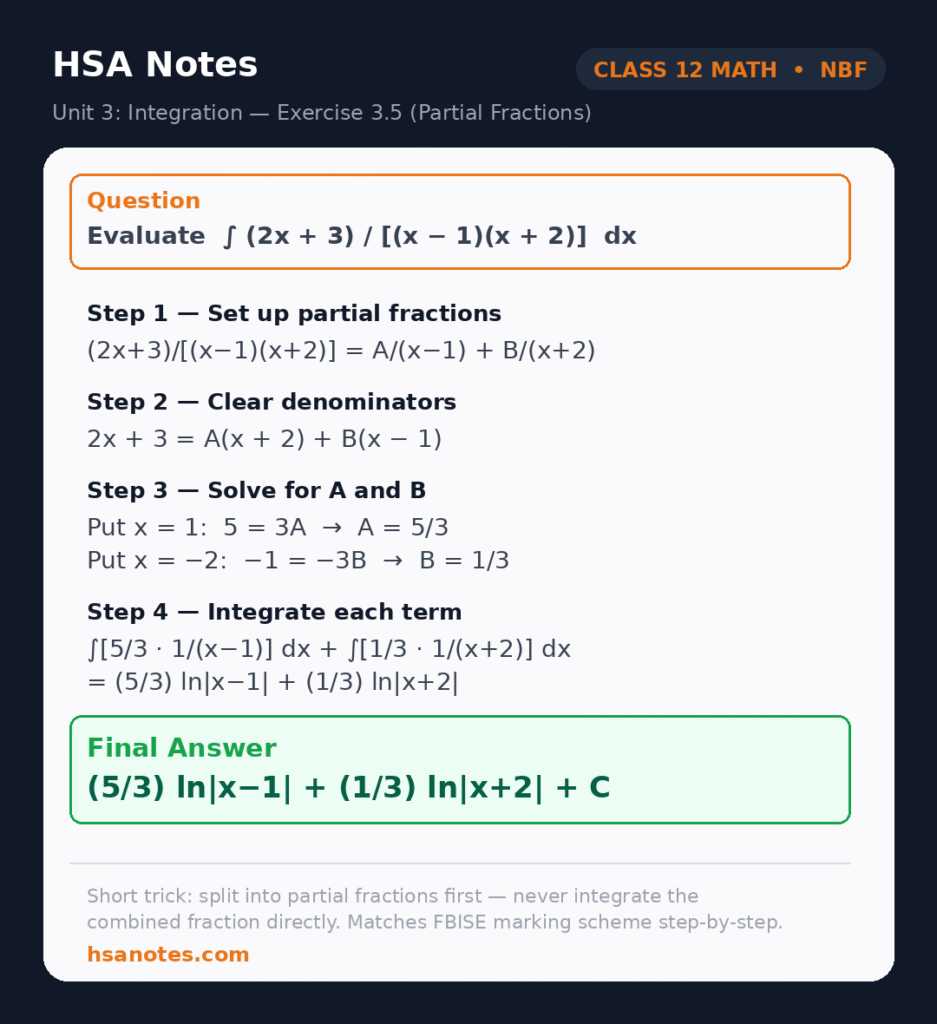
- Exercise 3.5 — Partial Fractions (Linear & Quadratic Denominators)
- Exercise 3.6 — Definite Integrals with Area Graphs
- Exercise 3.7 — Properties of Definite Integrals
- Exercise 3.8 — Applications: Area, Volume, and Arc Length
- Review Exercise, Unit 3 — MCQs and long questions, fully solved
These six exercises form the technical core of the unit. Substitution and integration by parts are the two workhorse techniques almost every later exercise depends on, so 3.3 and 3.4 get special attention on choosing the right substitution or LIATE order. Partial fractions in 3.5 is often where students lose marks, since it needs algebraic comfort as much as integration skill, so each question shows the full decomposition step before integrating. Exercises 3.6 through 3.8 bring the unit back to geometry — areas, volumes of revolution, and arc lengths — each with the original graph included so the region or solid is never left to the imagination.
Sample Questions
From Exercise 3.1:
- Evaluate ∫(3x⁴ − 2x + 5) dx
- Evaluate ∫xeˣ² dx
- Evaluate ∫(1/x) + eˣ dx
From Exercise 3.2:
4. Evaluate ∫sin³x cos²x dx
5. Evaluate ∫tan²x dx
From Exercise 3.4:
6. Evaluate ∫x ln x dx
7. Evaluate ∫x²eˣ dx
From Exercise 3.5:
8. Evaluate ∫(2x+3)/[(x−1)(x+2)] dx
From Exercise 3.6:
9. Evaluate ∫₀^π sin x dx and find the area between the curve and the x-axis
10. Find the area bounded by y = x² and y = x between their points of intersection
Why This Unit Matters
Integration is, in a real sense, the payoff for everything learned in Unit 2 every differentiation rule has a mirror-image integration technique, and recognizing which one to apply is the central skill this unit builds. Substitution and integration by parts, covered in 3.3 and 3.4, are used constantly throughout the rest of the course and reappear in disguised forms on nearly every FBISE paper. Partial fractions and definite integral applications, covered in 3.5 through 3.8, are consistently among the highest-weightage question types in Class 12 board exams, so thorough practice here pays off well beyond this one unit.
HSA Notes Features
- Complete solved exercises from 3.1 through 3.8, plus the review exercise
- Original textbook graphs included alongside step-by-step working
- Short tricks for faster problem-solving under exam time pressure
- Answers matching the FBISE marking scheme
- Full Unit 3 notes available to study online at hsanotes.com
Join Online Classes
Join HSA Notes online classes to strengthen your integration technique, and every other unit of Class 12 Math, with regular practice to help you aim for 90 plus marks in your FBISE HSSC-II board exam.
Contact: hsanotes48@gmail.com
Frequently Asked Questions
What’s the difference between an indefinite and a definite integral?
An indefinite integral gives a general antiderivative plus a constant, while a definite integral evaluates it between two bounds to produce a specific value, often an area or accumulated quantity.
How do I know whether to use substitution or integration by parts?
Substitution works when the integrand contains a function and its derivative (or a close multiple); integration by parts suits products of two different function types, like a polynomial times an exponential or trig function.
Why is partial fractions important in this unit?
Many rational functions can’t be integrated directly, but breaking them into simpler fractions with linear or quadratic denominators makes each piece integrable with standard formulas.
Are these notes aligned with the current FBISE NBF syllabus?
Yes, fully solved according to the New NBF Mathematics Book for Class 12, FBISE, 2024-25, following the official marking scheme.
Conclusion
With Unit 3, Integration, fully solved from Exercise 3.1 through the review exercise, Class 12 FBISE students have a complete, exam-ready resource covering one of the most technique-heavy units in the Math syllabus. Practice these solved exercises alongside past papers, and consider joining our online classes for guided, exam-focused preparation, to build the speed and accuracy needed for your HSSC-II board exam.
Best of luck for your Class 12 Math exam!