
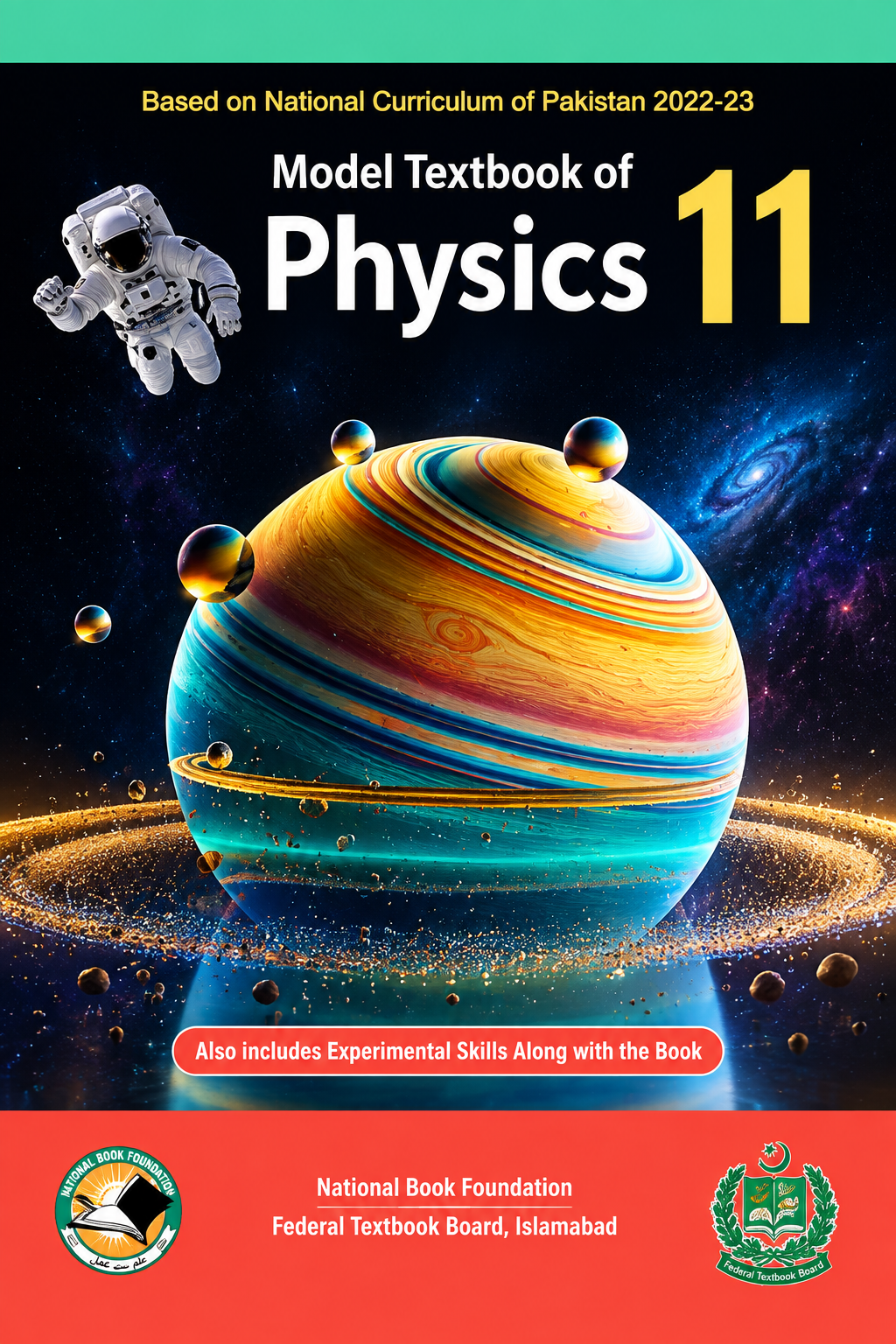
Introduction
HSA Notes brings complete, exam-focused solved notes to help Class 11 (1st Year, HSSC-I) students score high marks in their FBISE Physics board exam. This page covers Unit 1, Physical Quantities & Measurement, the foundation chapter of the entire Physics course, prepared strictly according to the FBISE New Book (NBF) 2024-25 syllabus.
Unit 1 Topic Overview
Physical Quantities and Their Types introduces the distinction between base quantities and derived quantities, along with the seven internationally recognized base units that form the SI system used throughout Physics. Understanding this classification early helps students recognize which formulas to reach for when solving multi-step numerical problems.
International System of Units (SI) covers the standard units of length, mass, time, electric current, temperature, amount of substance, and luminous intensity, along with the prefixes used to express very large or very small values, from nano and micro up to mega and giga.
Dimensions and Dimensional Analysis explains how to express any physical quantity in terms of the base dimensions of mass, length, and time, and how this technique is used to check the correctness of physical equations and derive relationships between quantities. This is one of the most frequently tested skills in board exams and appears repeatedly in later units too.
Errors and Uncertainties in Measurement covers systematic and random errors, absolute and percentage uncertainty, and how to correctly estimate the uncertainty in a final calculated result when combining several measured quantities through addition, subtraction, multiplication, or division.
Significant Figures deals with the rules for identifying, rounding, and reporting numbers to the correct number of significant digits, along with the rules for handling significant figures during arithmetic operations, a skill examiners check closely when grading numerical answers.
Scientific Notation and Prefixes covers how to write extremely large or small numbers in a compact, standard form, and how to convert between prefixes such as micro, milli, kilo, and mega without making conversion errors.
Precision and Accuracy of Measuring Instruments introduces common laboratory instruments such as the Vernier caliper, screw gauge, and physical balance, along with their least count and how to read them correctly, a topic that frequently appears in practical-based exam questions.
Official Youtube Channel: www.youtube.com/@FBISEOfficial
HSA Notes Features
- Complete solved MCQs based on the FBISE paper pattern
- Short-response questions with clear, to-the-point answers
- Long-response questions with step-by-step explanations
- Solved numericals with proper formulas, working, and correct units
- Solved textbook exercises covering every question
- Assignments and practice questions for self-assessment and revision
Sample Solved Numericals, Unit 1
| No. | Question | Solution |
|---|---|---|
| i | Express 0.000056 kg in scientific notation | 5.6 × 10⁻⁵ kg |
| ii | Convert 250 mg into kilograms | 2.5 × 10⁻⁴ kg |
| iii | Check the dimensional correctness of v = u + at | LHS: [LT⁻¹], RHS: [LT⁻¹] + [LT⁻¹] = [LT⁻¹], hence dimensionally correct |
| iv | Find the number of significant figures in 0.02030 | 4 significant figures |
| v | A length is measured as 5.6 cm using a ruler with least count 0.1 cm. Express with uncertainty | (5.6 ± 0.1) cm |
| vi | Derive the dimensions of force using F = ma | [F] = [M][LT⁻²] = MLT⁻² |
How to Approach Dimensional Analysis Questions
The method for solving dimensional analysis questions follows the same consistent steps every time. First, write down the standard formula or relationship connecting the physical quantities involved.
Second, replace each quantity with its base dimensions in terms of mass (M), length (L), and time (T). Third, simplify both sides of the equation and compare them; if the dimensions on both sides match, the equation is dimensionally correct.
When a constant or an unknown power is involved, the same method can be used in reverse, setting the dimensions of both sides equal to each other and solving for the unknown exponents. This technique also helps catch careless errors before submitting a final answer in the exam.
Why This Unit Matters
Physical Quantities & Measurement is not just an introductory chapter, it is the toolkit you will use throughout the entire Physics syllabus.
Dimensional analysis lets you verify formulas before applying them in later units such as Work & Energy, Waves, or Electromagnetism, saving valuable time during exams when you are unsure whether you have remembered a formula correctly.
Correct handling of significant figures and uncertainty ensures your numerical answers earn full marks, since FBISE examiners specifically check for proper unit expression, correct rounding, and appropriate use of scientific notation.
Students who master this unit early tend to lose noticeably fewer marks on numerical questions throughout the rest of the course, because these same skills are assumed and reused in every subsequent chapter.
Available Across All FBISE Institutions
These notes are built for students across all FBISE-affiliated institutions, including FG Schools, Model Colleges, ICB, IMCB, ICG, IMCG, and other public and private colleges under the Federal Board of Intermediate & Secondary Education, Islamabad.
About Our Notes
All academic resources are provided free of cost in PDF format, including detailed notes, guides and handouts, solved exercises and assignments, important and review questions, fill-in-the-blanks, and Multiple Choice Questions (MCQs), all prepared to match the official FBISE syllabus exactly.
Join Online Classes
Join HSA Notes online classes to strengthen your concepts in Physical Quantities & Measurement and every other unit of Class 11 Physics, with regular past paper practice to help you aim for 90 plus marks in your FBISE board exam.
Contact: hsanotes48@gmail.com
Frequently Asked Questions
What is the difference between base and derived quantities?
Base quantities are the seven fundamental quantities defined independently, such as mass, length, and time, while derived quantities are formed by combining base quantities, such as speed, which is length divided by time.
Why is dimensional analysis important in Physics?
It allows students to check whether a physical equation is correctly formulated by ensuring the dimensions match on both sides, and it can also be used to derive the form of an unknown relationship between quantities.
How do you determine the number of significant figures in a measurement?
All non-zero digits are significant, zeros between non-zero digits are significant, and leading zeros are not significant, while trailing zeros after a decimal point are significant.
Are these notes aligned with the current FBISE syllabus?
Yes, these notes strictly follow the FBISE New Course 2024-25 syllabus for Class 11 Physics, Unit 1.
Conclusion
With Unit 1, Physical Quantities & Measurement, fully covered, Class 11 FBISE students now have a strong foundation for every unit that follows in the Physics syllabus. This chapter’s concepts of units, dimensions, significant figures, and measurement uncertainty appear repeatedly throughout the course, so a solid grasp here pays off across the entire year. Practice the solved MCQs and numericals on this page alongside past papers, and consider joining our online classes for guided, exam-focused preparation, to build the accuracy and confidence needed for your board exam.
Best of luck for your Class 11 Physics exam!