
Introduction
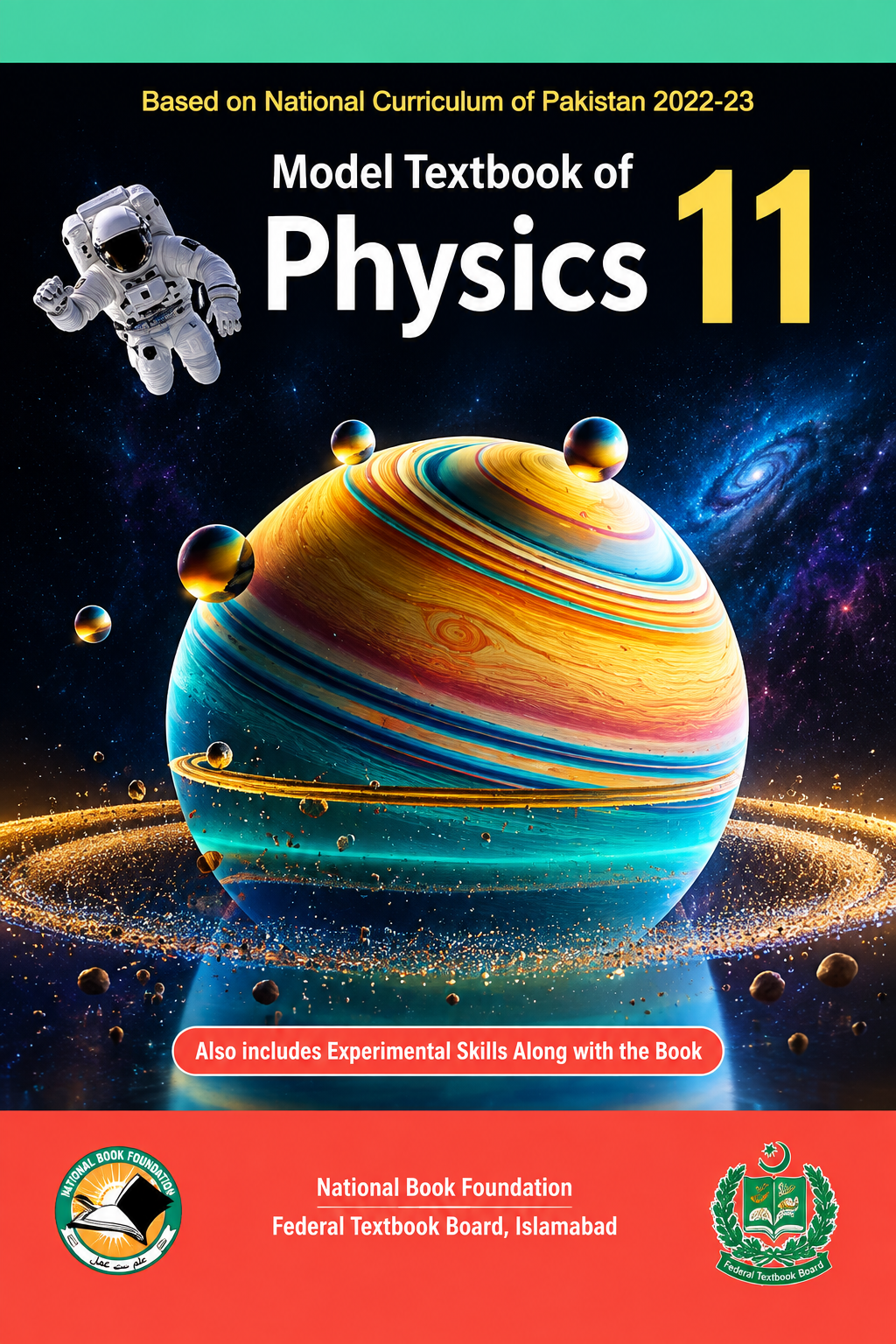
HSA Notes brings complete, exam-focused solved notes to help Class 11 (1st Year, HSSC-I) students score high marks in their FBISE Physics board exam.
This page covers Unit 13, Relativity, prepared strictly according to the FBISE New Book (NBF) syllabus, Cantab publisher, for the current academic session, covering special relativity, its postulates and consequences, and the concept of spacetime, along with fully solved examples, derivations, MCQs, short and long questions, numericals, and assignments from HSA Notes.
Definition and Explanation of Relativity
Relativity, developed by Einstein, describes space and time as relative rather than absolute, directly challenging the Newtonian view.
It encompasses special relativity, dealing with uniform (non-accelerating) motion, introduced in 1905, and general relativity, dealing with acceleration and gravity as a curvature of spacetime, introduced in 1915.
A frame of reference is simply a coordinate system used to measure the position, velocity, and acceleration of an object.
Inertial and Non-Inertial Frames
An inertial frame is one in which Newton’s First Law holds true: an object at rest remains at rest, and an object in motion continues at constant velocity, with no fictitious forces present. A non-inertial frame is one that is accelerating, where fictitious forces, such as the centrifugal force, appear to act on objects.
Example: A bus moving at constant speed represents an inertial frame, while the same bus while braking represents a non-inertial frame, since passengers experience a forward fictitious force.
Special Theory of Relativity and Its Postulates
Einstein’s special theory of relativity rests on two postulates:
- The laws of Physics are the same in all inertial frames of reference.
- The speed of light (c) is constant for all inertial observers, regardless of the motion of the light source or observer.
A classic thought experiment illustrating these postulates involves a light beam reflecting off a mirror inside a moving train; observers on the train and on the ground disagree on the path length traveled by the light, which leads directly to the consequence of time dilation.
Consequences of Special Relativity
Relativity of Simultaneity: Events that appear simultaneous in one reference frame may not appear simultaneous in another frame moving relative to it. A common illustration involves two lightning strikes hitting either end of a moving train, which appear simultaneous to an observer on the ground but not to an observer on the train.
Time Dilation: Moving clocks run slower relative to a stationary observer, given by:
Δt = Δt₀ / √(1 − v²/c²)
This result is derived using a light clock thought experiment, comparing the path length of light as seen by a stationary observer versus an observer moving with the clock.
Length Contraction: An object in motion appears shortened along its direction of motion, given by:
L = L₀ √(1 − v²/c²)
This result follows directly from the time dilation formula.
Mass Variation: The relativistic mass of an object increases with its speed, given by:
m = m₀ / √(1 − v²/c²)
Example: At a speed of 0.8c, the relativistic mass becomes approximately m ≈ 1.67 m₀.
Mass-Energy Equivalence: Einstein’s most famous result states that mass and energy are equivalent and interconvertible:
E = mc²
This principle explains the enormous energy released in nuclear reactions, where a small amount of mass is converted directly into energy.
Spacetime as a Four-Dimensional Model
Special relativity unifies space and time into a single four-dimensional framework called spacetime, where each event is described by four coordinates: (x, y, z, ct).
Spacetime diagrams are used to visualize the paths of objects, called worldlines, through this four-dimensional space. Minkowski space refers to the flat spacetime geometry used specifically in special relativity, as opposed to the curved spacetime of general relativity. Detailed derivations and short questions on spacetime are included in the full PDF.
Exercises Solved
Sample MCQs: The Theory of Relativity was proposed by Albert Einstein; a frame of reference is an arbitrarily fixed point used for measuring motion; a pendulum with a rest period of 5.0 s observed with a period of 10.0 s corresponds to a speed of approximately 0.866c; and light emitted from an airliner moving at 200 m/s still travels at speed c, like all light.
Sample Short Question: It is impossible for any object with mass to reach the speed of light, since relativistic mass increases without bound as v approaches c, requiring infinite energy to achieve that speed.
Sample Long Question: A full derivation of the postulates of special relativity, followed by each of its five key consequences: relativity of simultaneity, length contraction, time dilation, mass variation, and mass-energy equivalence.
Assignment 13.1: The speed at which an object’s length contracts to half its proper length is calculated as v ≈ 0.866c; for a pendulum with a rest period of 3 s observed by an observer moving at 0.95c, the observed period is Δt ≈ 9.608 s.
Numerical 13.1: The rest energy of an electron is calculated as 0.511 MeV.
Numerical 13.2: A 100 m spaceship moving at 0.99c has a contracted length of L ≈ 14 m.
Numerical 13.3: Pi-mesons moving at 2.70 × 10⁸ m/s, with a rest lifetime of 2.60 × 10⁻⁸ s, have a lab-frame lifetime of ≈ 5.96 × 10⁻⁸ s.
Numerical 13.4: A pi-meson with a lab lifetime of 1.40 × 10⁻¹⁶ s and rest lifetime of 0.840 × 10⁻¹⁶ s corresponds to a speed of v = 0.8c.
Full solved MCQs, short and long questions, numericals, and assignments are available in the complete PDF.
HSA Notes Features
- Solved MCQs, short, and long questions with clear, detailed answers
- Solved numericals with full working and correct units
- Solved assignments matching the current session’s syllabus
- Full Unit 13 Relativity notes for Class 11, based on the FBISE NBF course (Cantab publisher), at hsanotes.com
Why This Unit Matters
Relativity introduces a fundamentally different way of thinking about space and time compared to every other unit in the syllabus, and board exam questions frequently test conceptual understanding through short and long response questions rather than heavy numericals. A clear grasp of why time dilation, length contraction, and mass variation occur, rather than simple formula memorization, is essential for handling variations in exam questions confidently.
Join Online Classes
Join HSA Notes online classes to strengthen your concepts in Relativity and every other unit of Class 11 Physics, with regular past paper practice to help you aim for 90 plus marks in your FBISE board exam.
Contact: hsanotes48@gmail.com
Frequently Asked Questions
What are the two postulates of special relativity?
The laws of Physics are the same in all inertial frames, and the speed of light is constant for all inertial observers.
What is time dilation?
Time dilation is the effect in which a clock moving relative to an observer appears to run slower, given by Δt = Δt₀ / √(1 − v²/c²).
Why can’t an object with mass reach the speed of light?
Because relativistic mass increases as speed approaches c, requiring infinite energy to accelerate the object further.
What does E = mc² mean?
It expresses the equivalence of mass and energy, showing that mass can be converted into energy, as seen in nuclear reactions.
Conclusion
With Unit 13, Relativity, fully covered, Class 11 FBISE students now have a clear understanding of the postulates and consequences of special relativity, along with fully solved MCQs, short and long questions, numericals, and assignments for this session. Practice these solved exercises alongside past papers, and consider joining our online classes for guided, exam-focused preparation.
Best of luck for your Class 11 Physics exam!