
Introduction
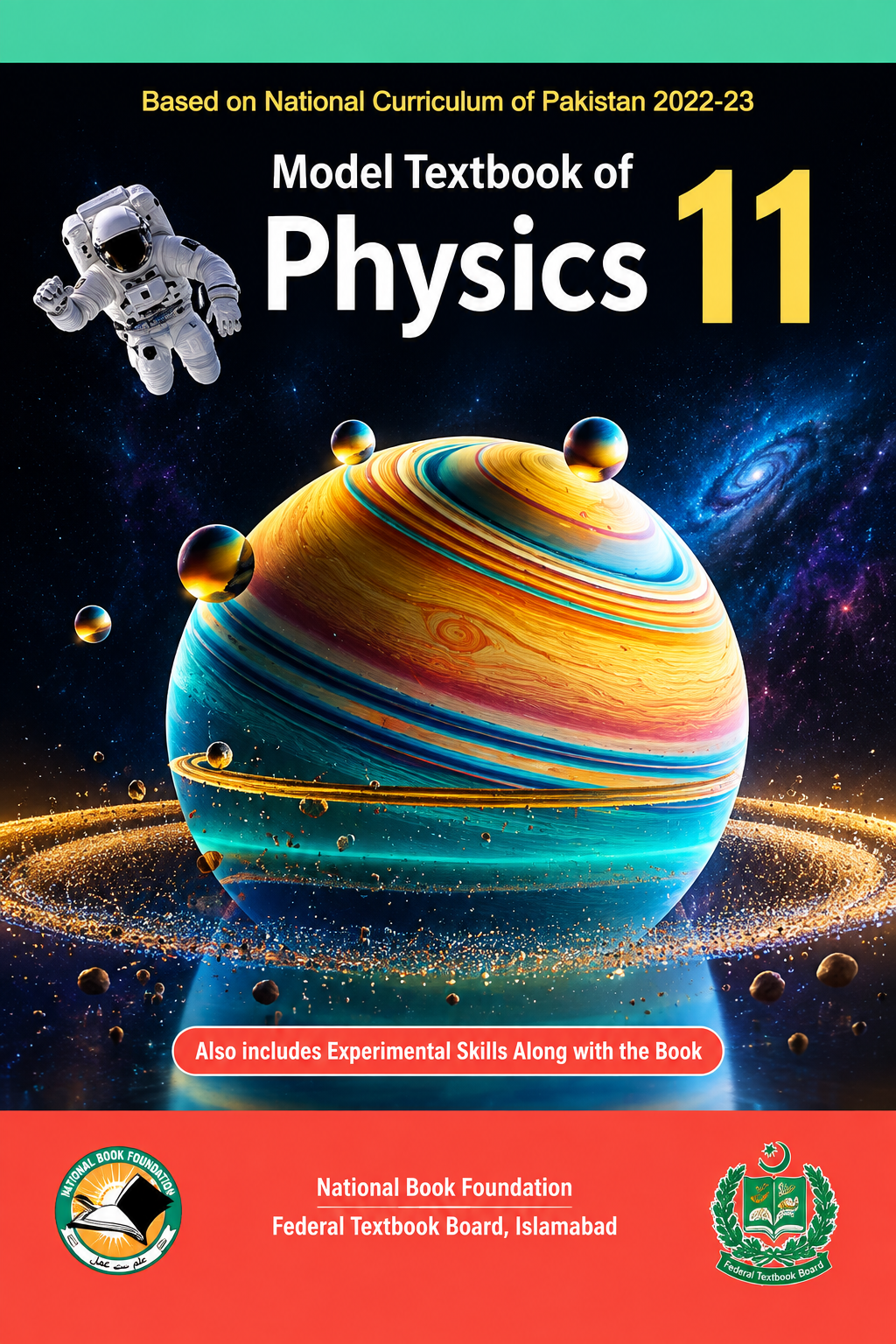
HSA Notes brings complete, exam-focused solved notes to help Class 11 (1st Year, HSSC-I) students score high marks in their FBISE Physics board exam. This page covers Unit 2, Vectors, prepared strictly according to the FBISE New Book (NBF) syllabus, based on the Hamdard Science Academy PDF, with easy explanations, derivations, worked examples, MCQs, short questions, numericals, and assignments.
Scalars and Vectors
Physical quantities in this chapter are divided into two categories based on whether direction is relevant to their description.
Scalars have magnitude only, with no associated direction. Common examples include mass, such as 5 kg, and speed, such as 60 km/h. Scalars can be added, subtracted, multiplied, or divided using ordinary arithmetic rules.
Vectors have both magnitude and direction, and this direction must always be specified for the quantity to be meaningful. Common examples include displacement, such as 10 m east, and force, such as 5 N downward. Vectors follow their own rules of addition and multiplication, which are covered throughout this unit.
Vector Resolution, Rectangular Components
One of the most important skills in this unit is resolving a vector into two perpendicular components, usually along the x-axis and y-axis. This technique simplifies vector addition and is used extensively in later mechanics problems involving inclined planes, projectile motion, and force analysis.
The horizontal and vertical components of a vector A making angle θ with the x-axis are given by:
A_x = A cos θ, A_y = A sin θ
Once resolved, the vector can be written in terms of unit vectors along the coordinate axes:
A = A_x î + A_y ĵ
Conversely, if the components of a vector are already known, its magnitude and direction can be recovered using:
Magnitude: A = √(A_x² + A_y²)
Direction: θ = tan⁻¹(A_y / A_x)
These two formulas are used constantly throughout the chapter’s numericals and should be memorized thoroughly, along with the correct quadrant rules for determining the angle θ.
Products of Vectors
Unlike scalars, vectors can be multiplied together in two distinct ways, each producing a different type of result and used in different physical contexts.
Dot Product (Scalar Product)
The dot product of two vectors produces a scalar quantity and is defined as:
A · B = AB cos θ
In terms of components, this can also be written as:
A · B = A_x B_x + A_y B_y + A_z B_z
The dot product is commutative, meaning A · B = B · A, and it becomes zero when the two vectors are perpendicular to each other, since cos 90° = 0. A key physical example of the dot product is work done, given by W = F · d, where only the component of force along the direction of displacement contributes to the work done.
Cross Product (Vector Product)
The cross product of two vectors produces another vector, whose direction is determined using the right-hand rule, and is defined as:
A × B = AB sin θ n̂
where n̂ is the unit vector perpendicular to the plane containing A and B. The cross product can also be calculated using the determinant form involving the unit vectors î, ĵ, and kn along with the components of each vector. Geometrically, the magnitude of the cross product equals the area of the parallelogram formed by the two vectors. A key physical example is torque, given by τ = r × F, which is used extensively in later units on circular and rotational motion.
Special Vectors
Several specific types of vectors appear repeatedly throughout this chapter and later units, and students should be comfortable identifying and working with each one.
- Unit Vector: A vector with magnitude exactly equal to 1, used to indicate direction only. It is calculated as â = A / |A|, where A is the vector and |A| is its magnitude.
- Null Vector: A vector with magnitude 0, having no specific direction, often resulting from the sum of two equal and opposite vectors.
- Position Vector: A vector that specifies the location of a point relative to the origin, written as r = x î + y ĵ + z kn.
HSA Notes Features
- Complete solved MCQs based on the FBISE paper pattern
- Short-response and comprehensive questions with clear answers
- Solved numericals with full working and correct units
- Solved textbook exercises covering every question
- Assignments and practice questions for self-assessment and revision
- Full vectors notes for Class 11 available in PDF form at hsanotes.com
Why This Unit Matters
Vectors are not an isolated topic; they are a tool used throughout the entire Physics syllabus. Rectangular components are essential for solving problems in Translatory Motion and Circular Motion, the dot product underlies the definition of work and energy in Unit 5, and the cross product underlies torque in rotational mechanics and later magnetic force calculations in Electromagnetism.
Available Across All FBISE Institutions
These notes are built for students across all FBISE-affiliated schools and colleges, including Islamabad Model Colleges, F.G. Colleges, Army Public Schools & Colleges, Punjab Colleges, Dr. A.Q. Khan Colleges, Fazaia Inter Colleges, IMCB, IMCG, and Sir Syed Colleges.
About Our Notes
All academic resources are provided free of cost in PDF format, including detailed notes, guides and handouts, solved exercises and assignments, important and review questions, fill-in-the-blanks, and Multiple Choice Questions (MCQs), all prepared to match the official FBISE syllabus exactly.
Join Online Classes
Join HSA Notes online classes to strengthen your concepts in Vectors and every other unit of Class 11 Physics, with regular past paper practice to help you aim for 90 plus marks in your FBISE board exam.
Contact: hsanotes48@gmail.com
Frequently Asked Questions
What is the difference between a scalar and a vector?
A scalar has magnitude only, such as mass or speed, while a vector has both magnitude and direction, such as displacement or force.
Why do we resolve a vector into rectangular components?
Resolving a vector simplifies calculations involving addition of multiple vectors and is essential for solving problems in mechanics, such as motion on an inclined plane or projectile motion.
What is the difference between the dot product and the cross product?
The dot product of two vectors produces a scalar quantity and involves cos θ, while the cross product produces a vector quantity, involves sin θ, and its direction is found using the right-hand rule.
Where can I find the full solved vectors notes PDF?
The complete Unit 2 Vectors notes, including solved MCQs, short questions, numericals, and assignments, can be studied online for free at hsanotes.com.
Conclusion
With Unit 2, Vectors, fully covered, Class 11 FBISE students now have a solid understanding of scalars, vectors, rectangular components, and the dot and cross products, all essential tools used throughout the rest of the Physics syllabus. Practice the solved numericals and MCQs on this page alongside past papers, and consider joining our online classes for guided, exam-focused preparation, to build the accuracy and confidence needed for your board exam.
Best of luck for your Class 11 Physics exam!