
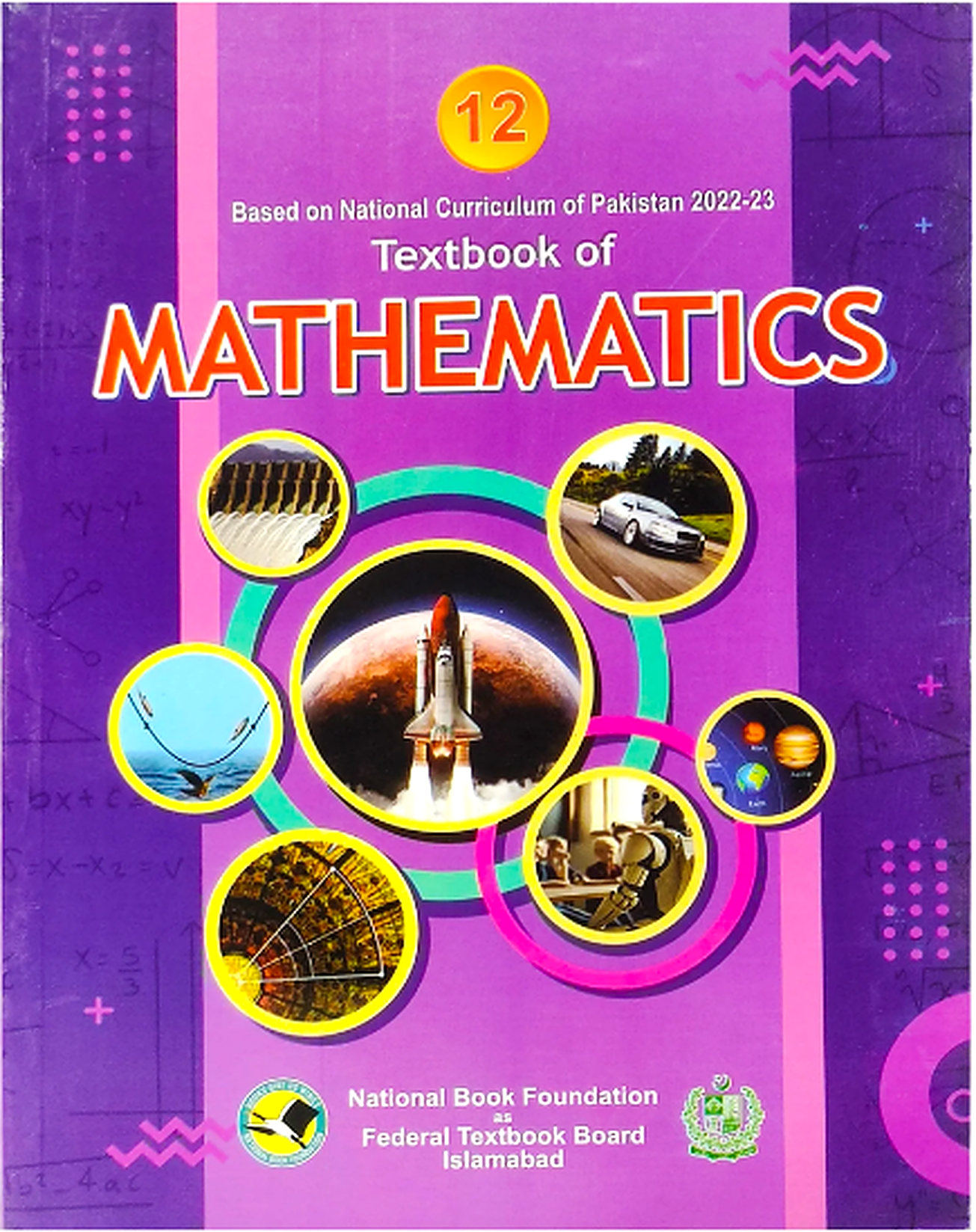
Introduction
100% solved Unit 10, Numerical Methods, from the New NBF Mathematics Book Class 12 FBISE 2026-27, complete with full iteration tables, step-by-step approximations, and answers matching the FBISE marking scheme, prepared by HSA Notes.
🎓 Online Classes with Experienced Experts
Perfect for FBISE HSSC-II exams , these notes are designed to help students score 90 plus marks with ease, and are equally useful for students and teachers at FBISE-affiliated institutions.
Unit 10 closes out the Class 12 Math syllabus by tackling equations that can’t be solved exactly with algebra, using repeated approximation instead to close in on a root.
It’s a shorter unit than most, spanning five exercises plus a review exercise, moving from the bisection method through false position, Newton-Raphson, the secant method, and finishing with interpolation and approximation.
Because every method in this unit relies on setting up and repeating the same iterative calculation correctly, careful, patient arithmetic at each step matters here more than in almost any other unit in the course.
Jump to: Exercise 10.1 | Exercise 10.2 | Exercises 10.3–10.5 | Review Exercise | Sample Questions
Exercise 10.1, Bisection Method (All Questions Solved)
Pages 629–632, Full Solutions with Iterations
- Exercise 10.1 Complete Solved + Iterations
- Choosing a Valid Starting Interval, Sign Change Check
- Q1, f(x) = x³ − x² + x − 7 on [2, 3], Root ≈ 2.10
- Q2, f(x) = x³ − 2x − 5 on [2, 3], Root ≈ 2.09
- Q3, f(x) = eˣ − 3x on [0, 1], Root ≈ 0.62
- Q4, f(x) = cos x − x on [0, π/2], Root ≈ 0.74
- Q5, f(x) = x³ − 9x + 1 on [2, 3], Root ≈ 2.94
Exercise 10.1 introduces the bisection method, the simplest and most reliable of the root-finding techniques in this unit.
Every question begins by verifying that the function changes sign across the chosen interval, since this is what guarantees a root actually lies inside it, before the interval is repeatedly halved and narrowed. The full iteration table is shown for each question rather than just the final approximation, so students can see exactly how the interval tightens step by step and can replicate the process on a similar function under exam conditions.
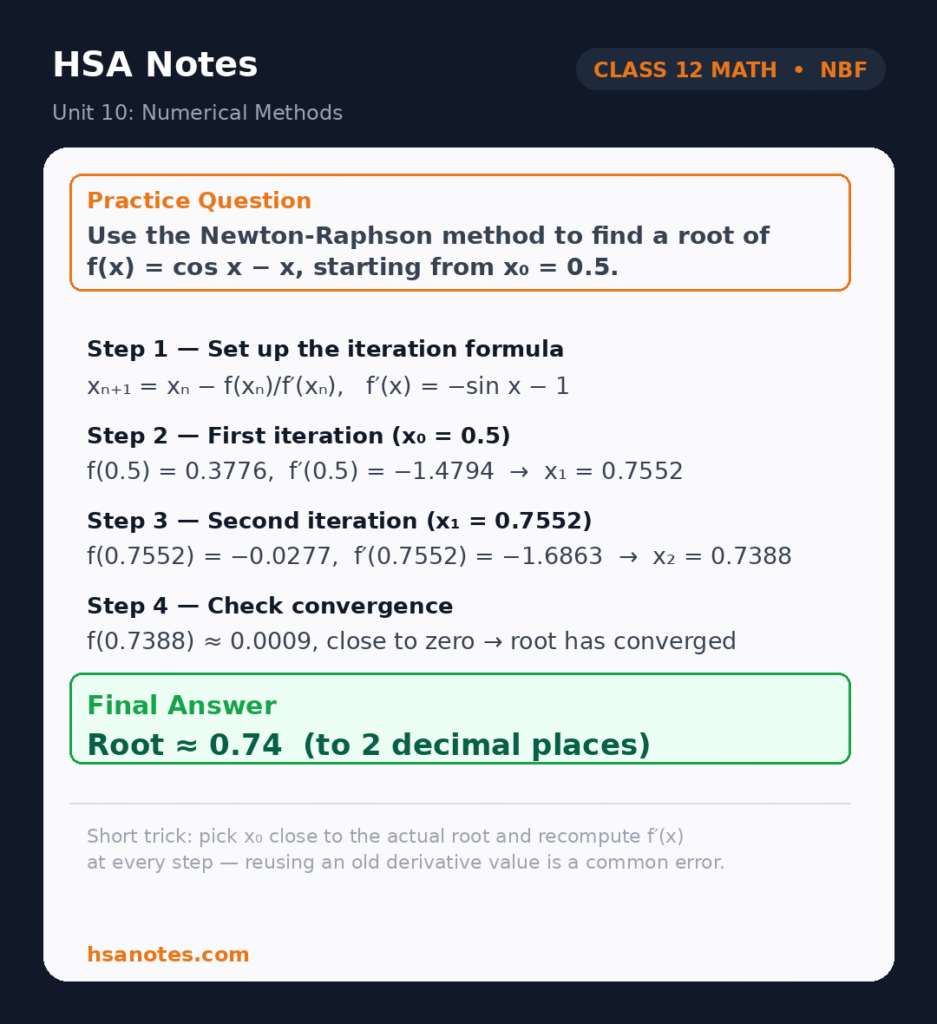
Step-by-step Newton-Raphson iteration finding a root of cos x minus x, starting from 0.5, showing two iterations and a convergence check reaching a final root of approximately 0.74.
Exercise 10.2, False Position Method
Full Solutions + Convergence
- Exercise 10.2 Complete Solutions
- Regula Falsi Iteration, Short Tricks
This exercise introduces the false position, or regula falsi, method, which uses a straight line between the interval endpoints rather than a simple midpoint to estimate the root, typically converging faster than bisection for well-behaved functions.
The notes place particular emphasis on the formula setup, since a sign error in the endpoint substitution is the most common mistake students make when first learning this method, and show how the iteration table is built one row at a time so the pattern is clear.
Exercises 10.3 to 10.5 + Review Exercise, Fully Solved
- Exercise 10.3 — Newton-Raphson Method
- Exercise 10.4 — Secant Method
- Exercise 10.5 — Interpolation & Approximation
- Review Exercise, Unit 10 — MCQs and long questions, fully solved
These closing exercises cover the remaining numerical techniques in the syllabus. Exercise 10.3 introduces the Newton-Raphson method, which uses the derivative of the function to converge on a root far more quickly than bisection or false position, making it a favorite in FBISE long questions — though it requires care in choosing a starting value close enough to the root for the method to converge at all. Exercise 10.4 covers the secant method, a close relative of Newton-Raphson that approximates the derivative using two points instead of computing it directly, useful when the derivative is difficult to find. Exercise 10.5 shifts from root-finding to interpolation, estimating unknown values between known data points, before the review exercise brings all five methods together in exam-style questions.
Sample Questions
From Exercise 10.1:
- Use the bisection method to find a root of f(x) = x³ − x² + x − 7 in [2, 3], correct to two decimal places.
From Exercise 10.2:
2. Use the false position method to find a root of f(x) = x³ − 2x − 5 in [2, 3].
From Exercise 10.3:
3. Use the Newton-Raphson method to find a root of f(x) = cos x − x, starting from x₀ = 0.5.
From Exercise 10.4:
4. Use the secant method to find a root of f(x) = eˣ − 3x, starting from x₀ = 0 and x₁ = 1.
From Exercise 10.5:
5. Given the data points (1, 2), (2, 5), and (3, 10), use interpolation to estimate the value at x = 2.5.
View the Full Original Notes
View the complete Unit 10 solved notes directly, no download needed: Open Complete Unit 10 Solved Notes
External Links
- FBISE Official → fbise.edu.pk
- NBF Textbook → nbf.org.pk
Why This Unit Matters
Numerical methods matter because most real-world equations simply can’t be solved exactly with algebra, and the techniques in this unit bisection, false position, Newton-Raphson, and the secant method are exactly what’s used in practice to approximate a solution to any desired accuracy.
Newton-Raphson, covered in Exercise 10.3, is consistently favored in FBISE long questions for its speed of convergence, but understanding why bisection and false position work first, covered in Exercises 10.1 and 10.2, makes the faster methods far easier to trust and apply correctly under exam conditions.
HSA Notes Features
- Complete solved exercises from 10.1 through 10.5, plus the review exercise
- Full iteration tables shown for every root-finding question
- Careful sign-change and convergence checks explained at each step
- Answers matching the FBISE marking scheme
- Full Unit 10 notes available to study online at hsanotes.com
Join Online Classes
Join HSA Notes online classes to strengthen your numerical methods technique, and every other unit of Class 12 Math, with regular practice to help you aim for 90 plus marks in your FBISE HSSC-II board exam.
Contact: hsanotes48@gmail.com
Frequently Asked Questions
How do you choose a valid starting interval for the bisection method?
By checking that the function’s values at the two interval endpoints have opposite signs, which guarantees, by the Intermediate Value Theorem, that at least one root lies somewhere between them.
What’s the difference between the false position method and bisection?
Bisection always splits the interval at its exact midpoint, while false position uses a straight line between the endpoint values to estimate a point closer to the actual root, which usually means faster convergence.
Why does Newton-Raphson sometimes fail to converge?
Because the method relies on the function’s derivative to project toward the root, a poorly chosen starting value, a derivative close to zero, or a function with unusual behavior near the root can cause the iterations to diverge instead of converging.
Are these notes aligned with the current FBISE NBF syllabus?
Yes, these notes are fully solved according to the New NBF Mathematics Book for Class 12, FBISE, 2024-25, and follow the official FBISE marking scheme.
Conclusion
With Unit 10, Numerical Methods, fully solved from Exercise 10.1 through the review exercise, Class 12 FBISE students have a complete, exam-ready resource covering the final and most computation-focused unit in the Math syllabus. Practice these solved exercises alongside past papers, and consider joining our online classes for guided, exam-focused preparation, to build the accuracy and confidence needed for your HSSC-II board exam.
Best of luck for your Class 12 Math exam!