
Introduction
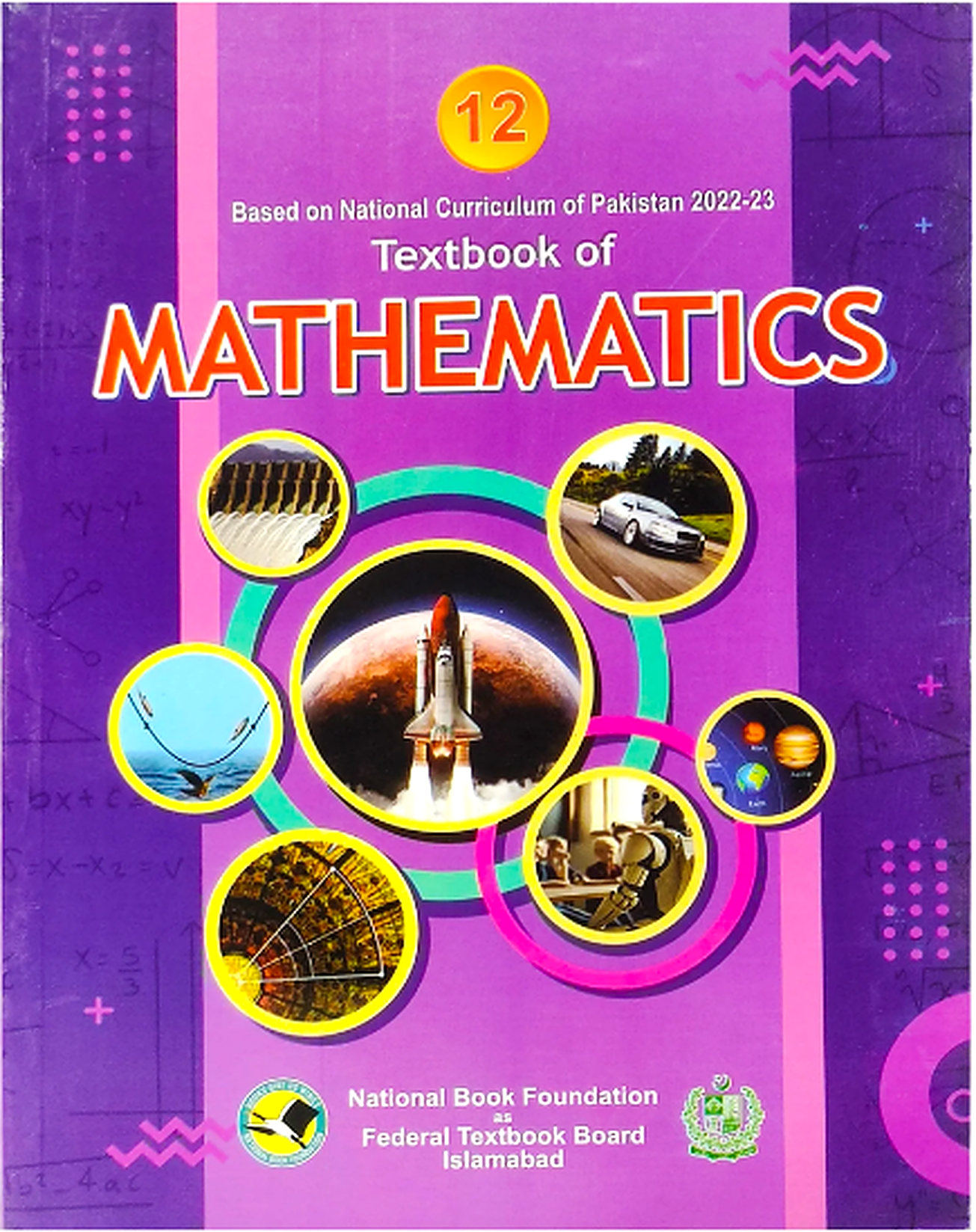
Struggling with Unit 1, Functions and Graphs, in your 12th Math FBISE NBF book? HSA Notes solves every question from Exercise 1.1 to 1.5, plus the review exercise, so students, teachers, lecturers, and experts can quickly master domain, range, inverses, bijectivity, and graphing using clear, easy-to-follow solutions.
🎓 Online Classes with Experienced Experts
Why These 12th Math Solved Notes Win
- Full Coverage: We solve all parts of Exercises 1.1–1.5 and the review exercise.
- Simple Steps: We use clear language and active voice.
- Exam-Focused: We match the latest FBISE NBF syllabus exactly.
- Visual Help: We include graphs and tables throughout.
Students revise fast, teachers save prep time, lecturers get ready-made homework assignments, and experts can verify proofs quickly.
Exercise 1.1, Domain, Range & Function Types
Key Concepts: The domain is the set of all possible input values (x-values) for which a function is defined; we look for values that cause problems, such as dividing by zero or taking the square root of a negative number. The range is the set of all possible output values (y-values) that result from the domain.
1. Find the Domain
| Function | Domain | Why? |
|---|---|---|
| f(x) = x² − 6 | ℝ | Polynomial — defined everywhere |
| g(x) = x / (x+3) | (−∞, −3) ∪ (−3, ∞) | Denominator ≠ 0 → x ≠ −3 |
| h(x) = (x+4) / (x²−9) | (−∞, −3) ∪ (−3, 3) ∪ (3, ∞) | x = ±3 make denominator zero |
| i(x) = x / (5x+2) | (−∞, −2/5) ∪ (−2/5, ∞) | 5x+2 ≠ 0 |
| j(x) = x / (x²+4) | ℝ | x²+4 ≥ 4 > 0 always |
| k(x) = √(x+1) | [−1, ∞) | Value inside square root ≥ 0 |
2. Find the Domain and Range
| Function | Domain | Range | Key Point |
|---|---|---|---|
| f(x) = x + 7 | ℝ | ℝ | Linear function |
| f(x) = 2x² + 1 | ℝ | [1, ∞) | Minimum at x=0, f(0)=1, opens upward |
| f(x) = 2√(x−5) | [5, ∞) | [0, ∞) | Starts at x=5, f(5)=0 |
| f(x) = |x−2| − 3 | ℝ | [−3, ∞) | Lowest point at x=2, f(2)=−3 |
| f(x) = 1 + sin x | ℝ | [0, 2] | Since sin x ∈ [−1,1] |
| f(x) = 3 + √(x−2) | [2, ∞) | [3, ∞) | Minimum at x=2, f(2)=3 |
| f(x) = 3eˣ | ℝ | (0, ∞) | Exponential is always positive |
| f(x) = (x²−16)/(x+4) | ℝ \ {−4} | ℝ \ {−8} | Hole at x=−4, simplifies to x−4 |
| f(x) = (x−1)² + 1 | ℝ | [1, ∞) | Minimum at x=1, f(1)=1 |
| f(x) = 1/(x−1) | ℝ \ {1} | ℝ \ {0} | Never equals zero |
| f(x) = (x−2)/(x+3) | ℝ \ {−3} | ℝ \ {1} | Horizontal asymptote at y=1 |
| f(x) = (x²−x−6)/(x−3) | ℝ \ {3} | ℝ \ {5} | Hole at x=3, simplifies to x+2 |
3. One-to-One & Onto
For A = {0, 1, 2, 3}, B = {p, q, r, s}, f = {(0,p), (1,q), (2,r), (3,s)}: since all outputs are distinct, the function is one-to-one, and since the range equals B, it is onto. Answer: one-to-one and onto.
4. Into or Onto
For A = {2, 3, 4, 5}, B = {b, c, d, e}, f = {(2,b), (3,c), (4,e), (5,e)}: since output e repeats, the function is not one-to-one, and since d is missing from the range, the function is into. Answer: not one-to-one, into.
5. Check One-to-One
(i) f(x) = 4x − 7 → One-to-one (assuming f(a) = f(b) leads to a = b)
(ii) f(x) = 6x² + 2 → Not one-to-one (f(1) = f(−1) = 8)
(iii) f(x) = (x³−1)/2 → One-to-one (a³ = b³ implies a = b)
6. Into Function
For g(x) = 2x² + 3x + 1 with domain {0,1,2,3}, the range is {1, 6, 15, 28}. Since the codomain {1, 6, 15, 28, 35} includes 35, which is missing from the range, the function is into.
7. Type of Function
For h(x) = 2x + 1, since it is linear with a non-zero slope, it is bijective.
8. Show Bijective
For f(x) = (x−2)/(x−3), A = ℝ \ {3}, B = ℝ \ {1}: cross-multiplying shows a = b, confirming one-to-one; solving for x = (3y+2)/(1−y), valid for y ≠ 1, confirms onto. Therefore, f is bijective.
9. Find Domain and Range of f⁻¹ and Verify
| Original | Inverse | Domain of f⁻¹ | Range of f⁻¹ | Verification |
|---|---|---|---|---|
| f(x) = 4x−3 | f⁻¹(x) = (x+3)/4 | ℝ | ℝ | f(f⁻¹(x)) = x |
| f(x) = x/(x−5) | f⁻¹(x) = 5x/(x−1) | ℝ \ {1} | ℝ \ {5} | Verified |
| f(x) = (x+2)/(x−1) | f⁻¹(x) = (x+2)/(x−1) | ℝ \ {1} | ℝ \ {1} | Verified |
| f(x) = √(x+2) | f⁻¹(x) = x²−2 (x ≥ 0) | [0, ∞) | [−2, ∞) | Verified |
| f(x) = x²+6 (x ≥ 0) | f⁻¹(x) = √(x−6) | [6, ∞) | [0, ∞) | Verified |
| f(x) = (2x−1)/(x+4) | f⁻¹(x) = (−1−4x)/(x−2) | ℝ \ {2} | ℝ \ {−4} | Verified |
Exercise 1.2, Graphing Made Easy
| Function | y-intercept | x-intercept | Slope |
|---|---|---|---|
| f(x) = 3x − 2 | (0, −2) | (2/3, 0) | 3 |
| f(x) = 3x | (0, 0) | (0, 0) | 3 |
| f(x) = 1 − 2x | (0, 1) | (1/2, 0) | −2 |
Fig 1: Rising line Fig 2: Line through origin Fig 3: Falling line
Exercises 1.3 to 1.5 + Review Exercise
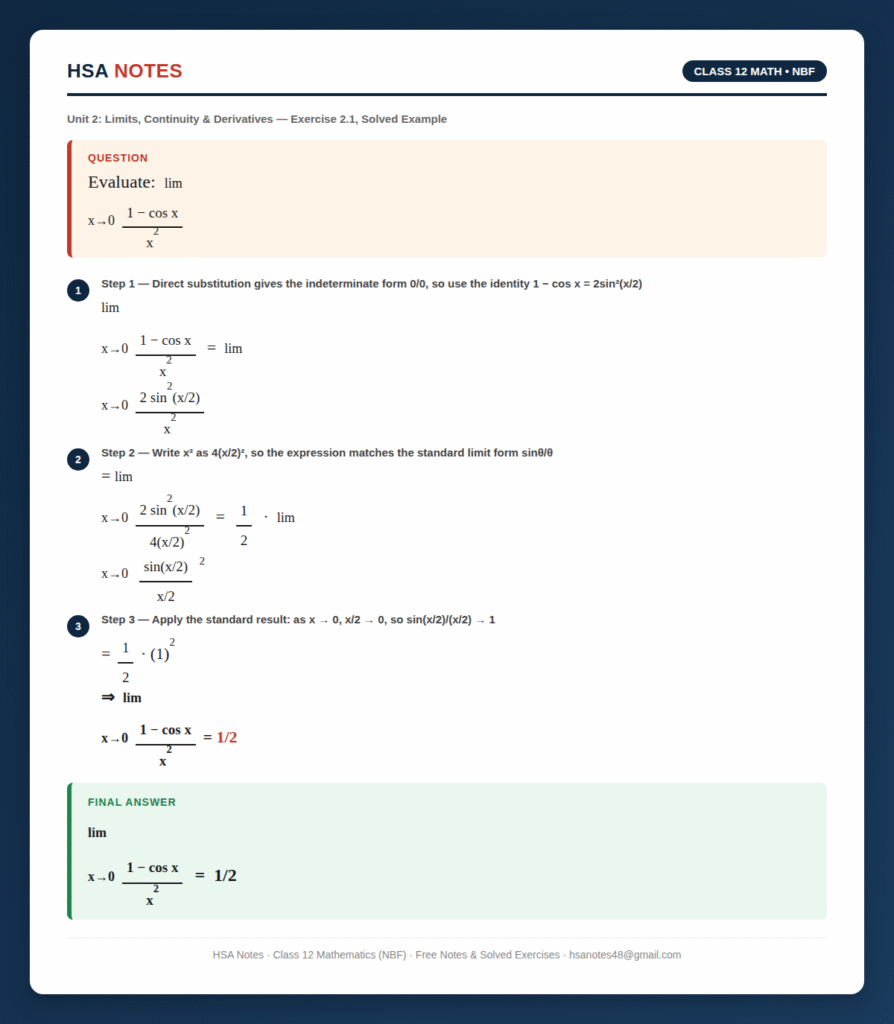
These sections cover function composition, piecewise functions, limits and continuity, and graph shifts. The review exercise includes 20+ questions, with step-by-step solutions aligned with the FBISE marking scheme.
Who Benefits?
| Students | Teachers & Lecturers | Experts |
|---|---|---|
| Revise Unit 1 in 2 hours | Ready-made lesson plans | Fast proof checks |
| Ace FBISE boards | Assign solved homework | Use in tutoring |
Join Online Classes
Need live help? Contact HSA Notes for guided, exam-focused preparation across Unit 1 and every other unit of Class 12 Math.
Contact: hsanotes48@gmail.com
Frequently Asked Questions
How do you find the domain of a rational function?
Identify the values of x that make the denominator zero and exclude them from the domain, since division by zero is undefined.
What is the difference between one-to-one and onto functions?
A one-to-one function maps distinct inputs to distinct outputs, while an onto function has a range that equals its entire codomain.
How do you verify that a function and its inverse are correct?
Substitute the inverse function into the original function, f(f⁻¹(x)), and confirm the result simplifies to x.
What topics are covered in Exercises 1.3 to 1.5?
These exercises cover function composition, piecewise functions, limits and continuity, and graph shifts, building on the domain, range, and inverse concepts from Exercises 1.1 and 1.2.
Conclusion
With Unit 1, Functions and Graphs, fully solved from Exercise 1.1 through the review exercise, Class 12 FBISE NBF students now have a complete, exam-ready resource for one of the most foundational units in the Math syllabus. Practice these solved exercises alongside past papers, and consider joining our online classes for guided, exam-focused preparation, to build the accuracy and confidence needed for your board exam.
Best of luck for your Class 12 Math exam!